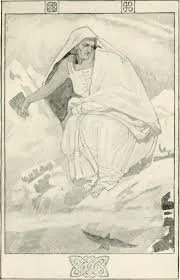
THE CAILLEACH
The Ancient One of Winter
The keeper of the cold, the wisdom of age, and the power of the untamed earth.
As we enter the darker half of the year, we meet the Cailleach, one of the most fascinating figures in Scottish and Irish folklore.
Often described as a divine hag, ancient woman, or powerful figure associated with winter, the Cailleach appears in different forms across Gaelic storytelling. Her name is related to an old Gaelic word for an old woman or veiled woman, and her stories vary across regions and generations.
She is often associated with mountains, storms, cold weather, and the shaping of the landscape. In Scottish tradition, she is closely connected with winter, and some stories portray her as a powerful force who governs the season. In certain traditions, she strikes the ground with her staff to bring frost and freezing weather. Other tales describe her as a giantess whose movements shape the land itself.
She is not simply a gentle grandmother of winter. The Cailleach can be fierce, formidable, and beyond human control. She represents the wildness of nature — the part that does not bend to our wishes or follow our schedules.
And perhaps that is exactly why she belongs in our reflections on Samhain.
The Wisdom of the Dark
The Cailleach invites us to reconsider the way we view winter, aging, and the natural cycles of life.
We live in a culture that often celebrates youth, constant growth, productivity, and visible beauty. Winter asks something different of us. The landscape becomes bare. Growth slows. The world seems to withdraw into itself.
But there is wisdom in this withdrawal.
The Cailleach reminds us that there is power in what has endured. There is knowledge that comes only through experience, strength that develops through hardship, and beauty that cannot be measured by youth or appearance.
She does not ask permission to grow old. She does not apologize for being formidable. She belongs to the mountain, the storm, the cold, and the untamed places of the world.
Through her, we can imagine an older kind of wisdom — one that does not need to be charming, agreeable, or easily understood.
What if we allowed ourselves that same freedom?
What if we stopped expecting every season of our lives to look like spring? What if we recognized that rest, solitude, and the shedding of old identities can be as important as growth and beginnings?
The Cailleach reminds us that not all transformation looks like blooming.
Sometimes transformation looks like becoming rooted, weathered, and entirely unwilling to abandon yourself.
The Cailleach and the Turning of the Year
The Cailleach is often connected with winter and the power of the land, making her a fitting figure to explore as we approach the darker months.
However, her relationship to Samhain is best understood as a connection within seasonal storytelling and modern pagan interpretation, rather than a claim that every Gaelic tradition identified her specifically with the Samhain festival.
In some Scottish folklore, she is associated with the creation of winter landscapes and the rule of the cold season. Other stories describe seasonal relationships between the Cailleach and figures associated with spring and summer.
These tales differ, but they share a powerful idea: the year moves through changing forces, and no single season lasts forever.
The Cailleach belongs to the part of the cycle when the land becomes harder, the weather more demanding, and life requires a different kind of attention.
She reminds us that winter is not an interruption of the natural world. Winter is part of the world itself.
Working with the Archetype
You do not need to claim the Cailleach as a personal deity or incorporate her into your spiritual practice to learn from her stories.
You might simply sit with what she represents: the wisdom of age, the force of nature, the courage to be misunderstood, and the acceptance of life's less comfortable seasons.
Consider these questions:
Where in my life am I being asked to become more resilient?
What wisdom have I gained through experiences I once wished I could avoid?
Where am I trying to force growth when what I really need is rest?
What would it mean to embrace a version of myself that is less concerned with pleasing others?
How can I learn to respect the natural world without expecting it to be gentle or convenient?
Let your answers be honest. They do not need to be beautiful or polished.
A Simple Cailleach Reflection Ritual
Find a quiet place outdoors, if the weather allows, or sit beside a window where you can observe the changing landscape.
Notice the bare branches, the fallen leaves, the darkening sky, or the signs of winter beginning to arrive.
Think about something in your life that has weathered a difficult season. It might be a relationship, a period of change, a personal challenge, or a version of yourself you have had to outgrow.
Rather than asking what you need to fix, ask what the experience has taught you.
Write down one truth you know now that you did not know before.
Then ask yourself what kind of strength you want to carry into winter. Not the strength of pushing through everything, but the strength of knowing when to stand firm, when to rest, and when to let something go.
Close with these words:
I honor the wisdom that time has given me.
I do not ask every season to be gentle.
I allow myself to rest, to change, and to stand in my own strength.
I welcome the wisdom of the dark.
A Final Thought
The Cailleach is not a figure who promises comfort. She reminds us that nature is powerful, that time changes everything, and that wisdom often comes through experiences we cannot control.
As we approach Samhain and turn toward winter, we can carry this lesson with us.
We do not have to remain forever young, forever blooming, or forever becoming something new.
There is dignity in what has endured.
There is beauty in what has weathered the storm.
And there is a particular kind of magic in learning to stand fully in the season we are in.
May the Cailleach remind us that winter has its own wisdom — and that we, too, are allowed to change with the turning of the year.