
ORIGINS OF LUGHNASADH-LAMMAS
Lammas, or Lughnasadh, is celebrated around August 1, marking the cross-quarter day halfway between the Summer Solstice (Litha) and the Autumn Equinox (Mabon). It is one of the four Celtic fire festivals, alongside Samhain, Imbolc, and Beltane, and signals the beginning of the harvest season.
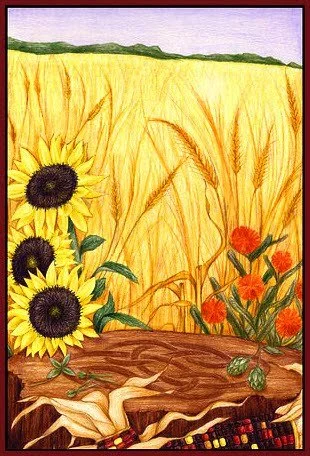
The landscape reflects this turning point beautifully. The flowers of early summer have begun their transformation into fruit. Fields of grain have ripened to gold. Gardens that were once bursting with blossoms are now offering tomatoes, cucumbers, herbs, berries, and squash. Nature reminds us that beauty is only one stage of growth—its purpose is to become nourishment.
Although Lammas and Lughnasadh are often celebrated together today, they come from different cultural traditions that honor the same seasonal threshold.
LUGHNASADH
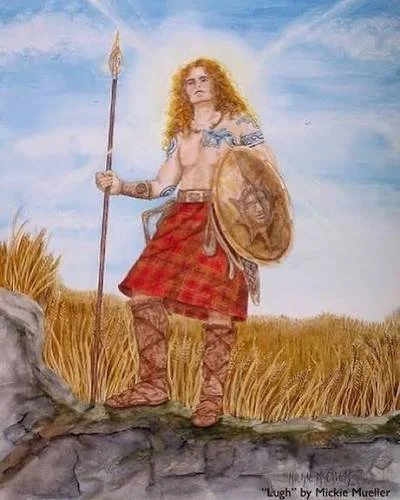
Lughnasadh (pronounced LOO-nah-sah) is the older Irish name for the festival, meaning "the assembly of Lugh."Lugh is one of the great deities of Irish mythology, celebrated as a master of many skills—craftsmanship, poetry, music, law, healing, metalworking, strategy, and leadership. Rather than representing a single talent, Lugh embodies the idea that true mastery comes through dedication, learning, and the continual refinement of one's gifts.
At the heart of Lughnasadh was the Óenach Tailten (Assembly of Tailtiu), one of the great seasonal gatherings of ancient Ireland. It was far more than a harvest celebration. It was a communal fair in the fullest sense, where people traveled from across Ireland to trade goods, settle disputes, arrange marriages, compete in athletic games, share stories, make music, and celebrate the abundance of the land together. The festival wove together the practical, the social, the spiritual, and the sacred.
According to Irish mythology, the festival was established by Lugh in honor of his foster mother, Tailtiu. She is remembered as the woman who cleared the great plains of Ireland so they could become fertile farmland. The labor was immense, and the stories tell us that the effort ultimately claimed her life.
Following her death, Lugh established funeral games at Tailteann in her memory. These games became an annual celebration that honored both Tailtiu's sacrifice and the harvest her labor made possible.
This story shapes the heart of Lughnasadh. Every harvest exists because someone—or something—labored before it. The grain did not simply appear. Fields were cleared. Seeds were planted. Crops were tended. The festival reminds us to honor not only the abundance before us, but also the work, devotion, sacrifice, and care that brought it into being.
The celebration continued throughout the medieval period, evolving over centuries while remaining tied to the rhythms of harvest and community.
LUGH: THE GOD OF SKILL, CRAFT, & THE HARVEST
At the center of Lughnasadh stands Lugh, one of the most revered deities in Irish mythology. While he is often associated with the harvest because this festival bears his name, Lugh's true significance extends far beyond the fields.
He is known as Lugh Lámhfhada ("Lugh of the Long Arm") and is celebrated as a god of skill, craftsmanship, creativity, and excellence. Ancient stories describe him as a master of many disciplines—warrior, blacksmith, carpenter, poet, musician, healer, lawgiver, strategist, and artisan. Rather than being defined by one talent, Lugh embodies the idea that every gift has value when it is cultivated with dedication.
His story reminds us that mastery is never accidental. Skill is earned through curiosity, practice, patience, and a willingness to keep learning. Every harvest—whether it comes from a garden, a creative project, a business, a relationship, or personal growth—is the result of consistent effort over time.
This is why Lugh is so deeply connected to the spirit of Lughnasadh. The first harvest is not only about gathering grain; it is about honoring the knowledge, labor, and craftsmanship that transformed tiny seeds into abundance. Just as Tailtiu's hard work prepared the land for cultivation, Lugh reminds us that every meaningful harvest begins with devotion to our craft.
During this season, we are invited to ask ourselves:
What skills have I been cultivating?
What gifts am I beginning to harvest?
Where has steady practice transformed me?
How can I use my talents in service to others?
Lugh teaches that abundance is not measured only by what we possess, but by what we are capable of creating. Lammas reminds us that our greatest harvests are often the skills, wisdom, resilience, and generosity we have grown along the way.
LAMMAS
Lammas represents a different cultural layer of this same seasonal turning.
The name comes from the Old English hlāfmæsse, meaning "Loaf Mass." In Anglo-Saxon England, on or around August 1, the first grain harvested from the fields was milled into flour, baked into a loaf, and brought to church to be blessed in thanksgiving.
Bread became the sacred symbol of the season because it represents transformation.
A field becomes wheat.
Wheat becomes flour.
Flour becomes dough.
Dough becomes bread.
Each step requires knowledge, patience, skill, and labor. The loaf represents far more than food—it is the visible expression of countless unseen acts of care. Bread reminds us that abundance becomes meaningful only through transformation.
TWO TRADITIONS, ONE THRESHOLD
Though Lughnasadh and Lammas arise from different cultures—the Gaelic Irish and the Anglo-Saxon—they both honor the same moment in the wheel of the year: the arrival of the first harvest.
Together, they invite us to pause between the exuberance of summer and the inward journey of autumn. They ask us not only to celebrate what has grown, but to recognize the labor that made it possible and to consider what we will now create from the gifts we've received.
This is the season of transformation.
Not simply gathering the harvest—but becoming worthy stewards of it.